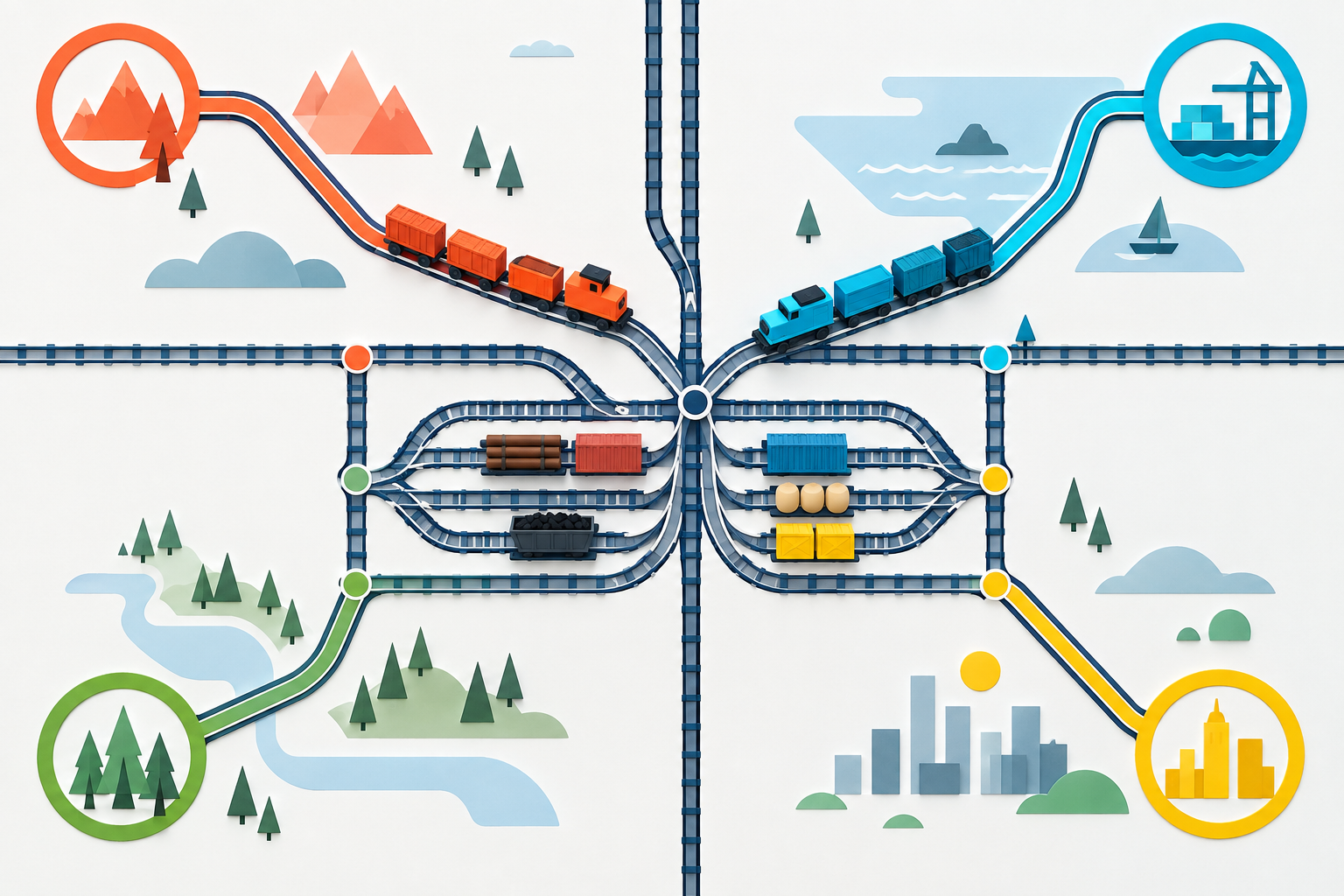
Two companies compete over 24 simultaneous dispatches. Deliver cargo to earn its printed value in points and cash. Highest points wins; remaining cash breaks a tie. If both match, share the victory.
1. Plan together, in secret
Each company starts with $4 and two trains. Pick one train to move, one junction to toggle (or keep every switch), and optionally one investment. Lock your order. It cannot be changed once locked. Your rival sees only that you are ready. When both are ready, everything resolves automatically.
2. The switches flip first
All investments happen first. Then the switch orders are combined. One toggle flips that junction between Route 1 and Route 2. Two toggles at the same junction cancel: it stays put.
At a junction, a forward train excludes the track it arrived on. Sort the other two neighbor labels alphabetically: Route 1 takes the first; Route 2 takes the second. The train cards and route preview show exactly where it will go. Your preview assumes your rival does not change another switch.
3. The trains roll together
Your chosen train moves one track; an upgraded train moves two, one tick at a time. Reverse takes the previous track on its first tick, then follows switches normally. Terminals have only one exit. On reaching its cargo destination, a train earns its reward, loads its next public cargo, and stops for this dispatch—even if it has movement left.
Opposing trains attempting a head-on track swap both stop. Opposing trains entering the same junction on the same tick also stop, unless either company has a siding there. A conflict cancels all their remaining movement for this dispatch. Parked trains wait off the running tracks and do not block traffic. Terminals can hold any number of trains.
4. Reinvest your delivery money
Each company gets $1 after every dispatch. An engine upgrade costs $8 and permanently gives that train two tracks per dispatch. A siding costs $3 and allows simultaneous arrivals at that junction. If exactly one company owns a siding at a shared arrival, the other pays it $1, or whatever cash it has left. If both own one, there is no toll. Sidings do not prevent head-on conflicts.
You can buy only one investment per dispatch, and it must be affordable from the cash you have before that dispatch. A newly bought upgrade or siding works immediately. Cargo rewards cycle through 3, 4, and 5; both companies follow mirrored delivery schedules. All trains, destinations, cash, scores, speeds, and sidings are public. Only the current orders are secret.
V1 balance will be shaped by your actual matches. The time estimate is provisional.